
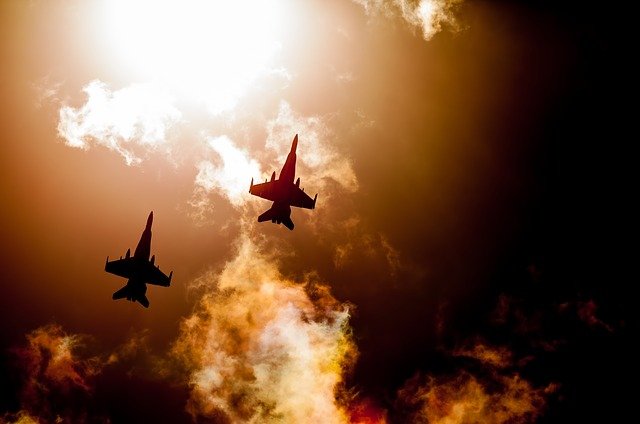
No one ever really wins in war. All parties involved suffer immeasurable losses. So it has been said, and history has verified this. But how different would history have been had Hitler and others been allowed to go unchecked? What precedent would that have set for future racist dictators? How should Christians view war?
Main Points
-
- We look at the different Christian schools of thought on war.
- War should be justified and only used as a last resort.
- War could be considered an international justice system.
DOWNLOAD FREE CHAPTERS FROM OUR NEW BOOKS
Christian Schools of Thought Concerning War
Holy War
These people believe that war is a duty to God. Proponents of this view included the Crusaders, who attempted to force others into Christianity. They claim that in Matt. 10:34-39 Jesus condoned such violence, when He vowed to bring a sword, not peace. In context however, Jesus was teaching that as followers of Him, we would be the objects of persecution and hatred, but we must be willing to sacrifice our lives for Him. He never taught us to kill for Him but to die for Him. The apostles, early Christians and church fathers were totally against violence and never physically resisted their persecutors. Unfortunately Holy War extremists have given Christianity a bad name. Many secularists continue to brandish Christianity as a violent religion because of the past abuses of this minority group, whom most believers today would not even categorize as true Christians.
Pacifism
These represent the other extreme in the Christian spectrum. Using scriptures like Matt. 5:39, they believe we should never resist evil, but always turn the other cheek. It is important to note that Jesus did not say to turn a blind eye. Furthermore, pacifists misunderstand one of the fundamental differences between the OT and the NT. In the OT God addressed nations, whereas in the NT He deasl with individuals. Jesus’ command to never retaliate applies to individuals, not nations.
Non-Violent Resistance
These differ from pacifists in that they allow for non co-operation and non-physical resistance to authority. Some may call it civil rebellion. They are the types to march in protest of military action, perhaps protest in other ways. The same arguments against pacifism applies here.
Just War
These believe that war is morally permissible under certain circumstances. This is the position that I espouse.
Conditions for War Today
Applying the principles of both Testaments today, we can arrive at the following.
War as a Last Resort
In Gen. 26:17-22 Isaac had a conflict with the herdsmen of Gerar over the ownership of certain wells. He chose not to fight, but to just move to another location until there was no more conflict. If this could always be achieved, the world would be a very peaceful place. I believe war should only be considered after diplomatic talks have failed, and military action remains the only remaining alternative.
Target Offenders Only
God commanded Israel to kill every man, woman, child and beast when taking possession of the Promised Land. There was a specific reason for this. God knew that had they left any trace of the enemy intact, it would eventually become a snare to them to entice them to follow pagan gods (Judges 2:3). This could be called the lesser of two evils – to kill them rather than allow them to seduce God’s people. In the NT of course, the presence of the ungodly is not a snare to Christians, but an opportunity for evangelism. Thus for wars today to be effective, civilian life should be protected as much as possible, otherwise we would have fallen into the same sin as the offenders.
Costs Should be Weighed
Prov. 20:18 urges us to seek proper counsel and guidance in waging war. Jesus taught that it was wise to count the costs before going out to war (Luke 14:31-33). This is necessary to determine if the desired mission could be accomplished by military action, if it is worth accomplishing and what the possible losses would be. President GW Bush should have read Luke 14 before launching his personal crusade against Saddam Hussein.
The Church Should Leave it to the Relevant Authorities
There is no such thing as a Christian holy war. For that matter there is no such thing as a Christian nation [4]. War does not involve the church. Jesus never teaches us to fight against other religions in a physical way. The Crusaders and the Catholics of the Dark Ages were wrong. I re-emphasize that war concerns governments and nations, not churches. When the church gets too involved in war and politics, what you end up with are people like Pat Robertson. He averred that the US should undertake a covert operation to take out Hugo Chavez (president of Venezuela) without waging war against his country. After the ensuing media frenzy, he clarified his statement. By “take out”, he did not mean “kill”, but “kidnap”. He actually thought he was making things better.
Conclusion
War is never ideal. According to Isa. 2:4, the ideal means of settling disputes is through wise counsel and dialog. Unfortunately that same verse teaches that only when Jesus sets up his physical kingdom on earth to rule over the nations will such peace reign among people. Between now and then, as long as sinful man is allowed to govern certain parts of the earth, abuse is inevitable. Such abuse must be dealt with by those who are capable of doing so. I believe God holds them accountable for that.
NOTES
[1] Although God claimed the right to vengeance in Deut. 32:35, this verse speaks of Him reserving the right to vengeance on Israel’s enemies, not personal offenders against individuals.
[2] Note that not every war was sanctioned by God. Some were carried out apart from Him.
[3] I am speaking of those who refuse to defend their families for “religious reasons”, not those who were overpowered by their attackers.
[4] There are not Christian states in the same way that there are Islamic states. Some countries however try to build their laws on Christian principles, and this is very noble. But Christianity is an individual matter. Many would like to call USA a Christian nation, but it is questionable whether a country that tolerates gays, practices abortion, and forbids prayer in public schools could be considered that. The church may or may not support the nation in its bid for war.
Some may object to the church supporting war on the basis that if we are perceived to be a Christian nation, our chances of ever evangelizing the “enemy” would diminish. But how could we gain a moral advantage to witness to a Kuwaiti if we had it in our power to help them and did nothing? The Church’s job is to pray for peaceable living and for God to be glorified in all things. It should keep at its focus evangelism of the lost, and not vengeance.
Get our books on Amazon